
The Scarcity Mindset: Why You're Always Chasing the Next Thing (And What to Do About It)
Updated: Apr 26
Can I be honest with you about something a little embarrassing?
I love buying things. Not shopping, exactly. But finding the next thing. My current obsession is books. I want all the knowledge, all the insight, all the learning I can get my hands on. I have more books than I will ever read in my lifetime and I am still looking for more.
Then there are the clothes. I have SO MANY clothes. My closet is full. I know this. And yet, the second I get a text from Maurices, I want to check. Every store I walk into, I look.
And office supplies. Do not even get me started on office supplies. Felt tip pens, notebooks, planners, binders. Every time I see a new one I think: if I just get all of these, I will finally be organized and focused. The reality? They stack up. And I am still not more organized.
Sound familiar? Maybe not the same categories. But something. There is always something.
Then I Read Scarcity Brain
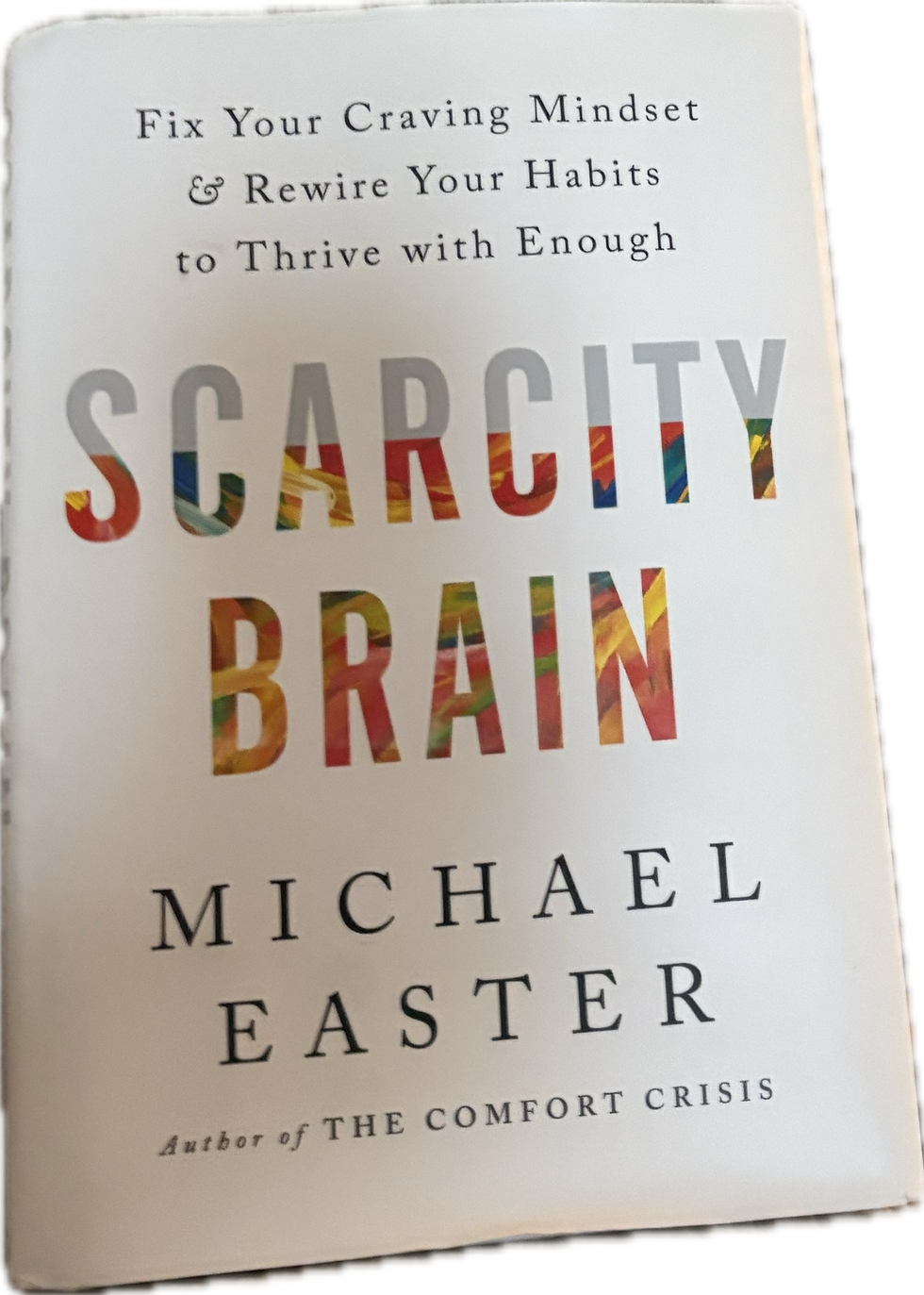
A few weeks ago I read Scarcity Brain by Michael Easter, and I have not stopped thinking about it since. Easter spent years researching why our brains default to wanting more, no matter how much we already have. What he found is both unsettling and completely liberating once you understand it.
Here is the short version: your brain evolved in a world where resources were genuinely scarce. Food, shelter, safety, warmth. Getting more of those things meant survival. So your brain developed a powerful drive to acquire, accumulate, and keep seeking. It was a feature, not a bug.
The problem is that your brain is still running that same software in a world of abundance. There is no shortage of clothes, books, or felt tip pens. But your brain does not know that. It still treats every sale, every new item, every "limited time offer" like it is something you need to secure before it disappears.
Your brain evolved to chase more. The world changed. Your brain did not get the memo.
Why We Love Stuff (According to Science)
Anthropologists at the University of Texas have a theory about why humans are wired to accumulate. They believe there are three reasons we evolved to love material goods.
First, stuff helps us survive. Having the right things at the right quantities provides protection, comfort, and the ability to trade for what we need. That is a completely rational instinct from a completely different era.
Second, stuff signals status. Nobody buys a Louis Vuitton bag just to carry their things. Scarcity and exclusivity are the secret ingredients in luxury marketing. Scientists at Temple University found that scarcity cues, the belief that something is hard to get or limited, outperform popularity cues every time. Your brain reads "limited edition" and something lights up.
Third, stuff helps us feel like we belong. The brands we buy, the logos we display, the communities we shop with. It is social and it is deeply human. We have been stamping brands on items for thousands of years.
None of this is a character flaw. It is biology. But understanding it changes everything.

The Loop That Keeps You Buying
Easter describes what he calls the scarcity loop: opportunity, unpredictable reward, and quick repetition. It is the same loop behind slot machines, social media, and yes, shopping.
You spot a sale. You browse. Maybe you find something, maybe you do not. You buy it. And then almost immediately, you start looking for the next thing. The satisfaction is real, but it is brief. And the loop starts over.
Sound familiar? I told you.
In the book, Easter spends time with a woman named Zerra, whose relationship with possessions is completely different from most of ours. Zerra sees everything she owns as gear. Her standard for any item is simple: it must earn its weight. It has to serve multiple functions and have a real purpose. If it does not, it does not come home with her.
Everything I own must earn its weight. It has to serve multiple functions.
That one sentence hit me harder than I expected.
The Psychic Weight Nobody Talks About
Here is what stayed with me most. Easter noticed something about the people he met who had the most stuff. The more they had, the less present they seemed to be. They were more involved in the future. Managing things, maintaining things, thinking about the next thing they needed.
There is a psychic weight to accumulation. Every item you own takes up a little mental space. Every purchase you are thinking about takes a little attention. Multiply that by a closet full of clothes, a pile of books, a drawer of office supplies you never use, and you are carrying around a lot of invisible weight every day.
And here is where it stops being about stuff and starts being about everything else.
How the Scarcity Mindset Shows Up at Work and at Home
The scarcity loop shows up everywhere. At work, it looks like always chasing the next title, the next project, the next recognition, without ever really landing in the one you are in right now. At home, it looks like already mentally redecorating before you have even settled into the house you bought. In relationships, it looks like focusing on what is missing in the people around you instead of what they bring.
We are a species that is really good at living slightly ahead of ourselves.
Easter also writes about something that stopped me completely: if we push back against our tendency to always add more, to solve our problems by buying something or chasing something, we often solve them better. More creatively. More efficiently. Creativity and efficiency bloom under scarcity. When we have to work with what we have, we often discover we already have more than we thought.
There is also something Easter touches on about how we see people. When we approach others with even a small amount of compassion and real interest, when we give people the benefit of the doubt instead of fitting them into a negative narrative, we find that people are amazing. We find that people are doing the best they can with what they have. But if we are always focused on what is lacking, in our stuff, in our circumstances, in the people around us, that is all we will ever find.
If we focus on the negative, we look for negatives. But if we approach things with even a small amount of compassion and real interest, we find that people are amazing.
What Gratitude Actually Does
In yesterday's Sunday email, I shared three gratitudes from my week. Credit goes to Steve Ludwig, who introduced the practice to our group during his session at MPSI this week. It was simple, nothing complicated. But after reading Scarcity Brain, I understand it differently now.
Gratitude is not just a nice habit. It is a direct interruption of the scarcity loop.
When your brain defaults to "not enough," gratitude is the practice of deliberately looking at what you already have. It is the neurological equivalent of Zerra's gear philosophy applied to your whole life. What do I already have that is serving me well? What is already here that I would miss if it were gone?
That is not settling. That is presence. And presence is the thing the scarcity loop is always stealing from you.
Easter writes about a motto he developed for the hard moments: "No problem, no story." Every good story has a complication. The challenge, the uncertainty, the moment where things do not go as planned. If we spend all our energy trying to eliminate those moments or buy our way past them, we lose the story. We lose the growth. We stop becoming the hero of our own journey.
The same is true for contentment. It is not found on the other side of the next purchase or the next achievement. It is found in the practice of pausing, right now, and recognizing what is already good.
Try This This Week
Before you check that sale email, open that shopping app, or add one more thing to your cart, try this first. Name three things you already have that are genuinely good. Not things you are working toward. Not things you wish were better. Things that already exist in your life right now, today.
It does not have to be big. It just has to be real.
That practice is not about deprivation. It is about interrupting a loop that your brain runs automatically, and choosing, for just a moment, to be here instead of always reaching toward what is next.
You might be surprised how much is already here.
As always, carry social kindness with you everywhere you go. The world needs you and your positive mindset!
Connect With Me

If you want to consult on training or coaching for your team, please reach out.
269-621-5282


Comments